
Where hair color comes from
Every hair follicle contains melanocytes — cells that manufacture melanin, the pigment responsible for hair color. Two kinds of melanin are involved: eumelanin, which produces brown and black tones, and pheomelanin, which produces red and yellow. The ratio between them, and how much of each you make, determines your natural shade.
Melanocytes are used up during each hair growth cycle and replaced from a reserve of melanocyte stem cells stored in a part of the follicle called the bulge. As long as that resupply keeps working, hair keeps its color. Gray hair is simply what grows when it stops.
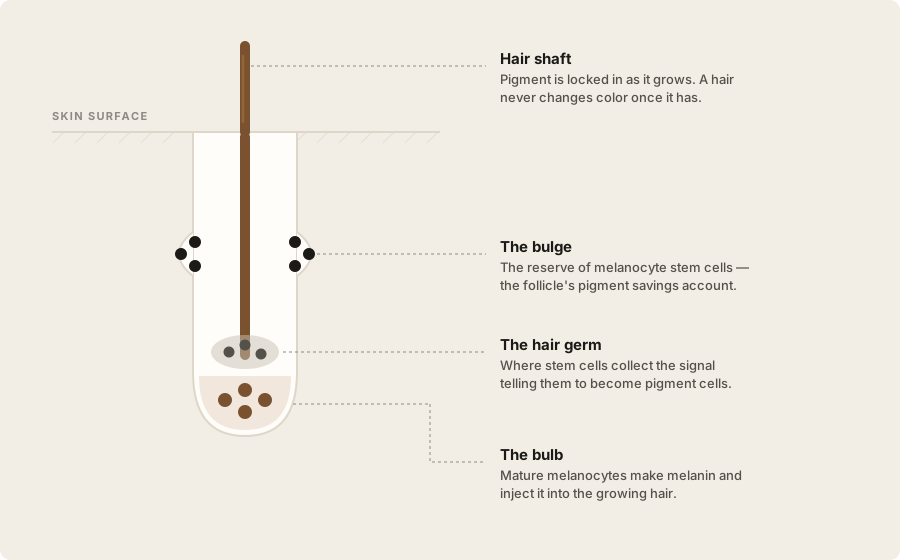
Worth knowing: an individual hair never changes color. It grows in either pigmented or not. What you observe as your hair "turning" gray is really individual follicles switching over, one at a time, over years.
Why the resupply fails
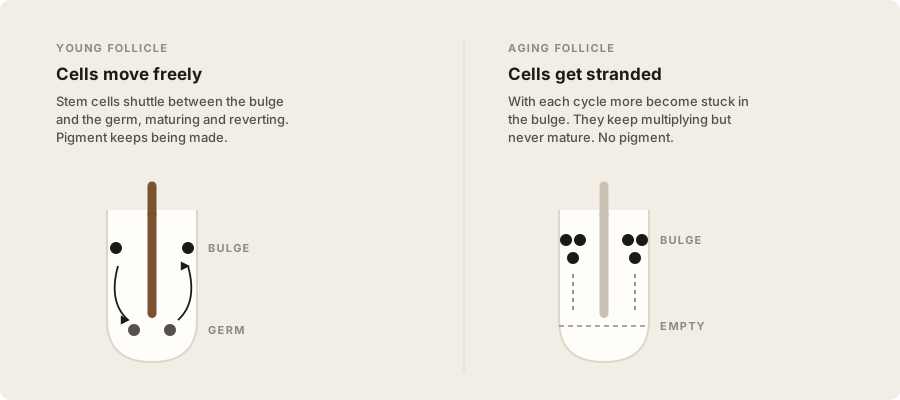
Until recently the assumption was that melanocyte stem cells simply die off. Research published in Nature in 2023 by a team at NYU suggests something more interesting: they get stuck.
These stem cells normally shuttle back and forth between two compartments of the follicle, maturing in one and reverting to a primitive state in the other. It's in the second compartment that they pick up the signals telling them to become pigment-producing cells. With each successive growth cycle, more of them become trapped in the bulge — still multiplying, but no longer able to make the return trip, and so never maturing into anything that makes pigment.
It's a mechanism, not a treatment. Nothing on sale today acts on it. But it does explain why graying accumulates gradually rather than arriving all at once.
When it typically starts
Mostly when your genes say so. Onset varies considerably between populations: it tends to begin earliest in people of European descent, with Asian and African populations graying roughly a decade later on average.
The rough thresholds for "premature" are before 20 in white populations, before 25 in Asian populations, and before 30 in Black populations. Below those ages it's worth investigating rather than accepting — not because it's dangerous, but because there's a reasonable chance of a correctable cause.
Above them, it's just the schedule you inherited.
What actually influences it
- Genetics. By far the strongest factor. A 2016 genome-wide study of more than 6,000 people identified IRF4 as the first gene associated with human graying, and estimated genetics accounted for roughly 30% of the variation.
- Age. Melanocyte stem cell function declines in nearly everyone, and it fails earlier than the stem cell system that grows the hair itself.
- Oxidative stress. Making melanin produces hydrogen peroxide as a by-product. Follicles neutralize it well when young and less well later, and the accumulation interferes with pigment production.
- Psychological stress. Real, and now mechanistically explained — but secondary to genetics, and partly reversible in some cases.
- Smoking. One of the few lifestyle factors that shows up consistently in the literature.
- Nutritional deficiency. Low B12, ferritin or vitamin D can play a part, particularly where graying arrives early. Worth a blood test.
- Medical conditions. Thyroid disorders, vitiligo and some autoimmune conditions are associated with early graying. Patchy or sudden color loss warrants a doctor, not a supplement.
Can it be reversed?
Not reliably, and not by anything currently for sale. That's the honest headline, and everything else is a qualification of it.
Recently grayed hairs do sometimes regain pigment on their own — a 2021 Columbia University study documented this in individual human hair shafts for the first time. Graying driven by a correctable deficiency or a treated medical condition can improve. And repigmentation occasionally turns up as a side effect of unrelated medications, which is a curiosity rather than an option.
What has never been demonstrated is a supplement, shampoo, serum or device that restores color to hair that has already turned. When a product claims otherwise, ask which trial supports it — and who funded that trial.
The claims people repeat, checkedFive things people believe that aren't true
False
Pluck one and three grow back
Each follicle produces exactly one hair, and plucking does nothing to its neighbors. The hair that regrows from that follicle will be gray again, because that follicle has stopped making pigment. Repeated plucking can damage a follicle permanently — which is a reason not to do it, but not the reason people think.
False
Hair can turn white overnight
The Marie Antoinette story is durable and impossible. Pigment is locked into the hair shaft as it grows; existing hair cannot lose its color. What can happen quickly is a condition where pigmented hairs shed preferentially, leaving already-white hairs behind and creating the appearance of a sudden change.
Mostly false
Stress is the main cause
Stress is a genuine contributor with a documented biological mechanism, but it accelerates a process that was going to happen anyway rather than starting one. Genetics and age dominate. The research on this is worth reading properly →
Misread
Bryan Johnson reversed his gray hair
In an October 2024 post he wrote that at 46 he had a full head of hair and roughly half his gray was gone. That one sentence got detached from the article around it, which is about hair loss. His protocol — minoxidil, dutasteride, latanoprost, red light therapy — targets follicle miniaturization, and none of it has an established mechanism for restoring melanin. The gray remark is an unquantified self-report from someone running dozens of interventions at once with no control condition, and to his credit he doesn't claim otherwise. Blueprint's own hair range is sold for hair loss, not pigment.
False
Antioxidant supplements stop it
Oxidative stress genuinely features in the biology, which is why antioxidants are marketed so heavily for graying. Marketing is not evidence. No antioxidant supplement has shown a convincing effect on human hair pigment in clinical use.
Gray or white? And gray or grey?
Gray hair isn't a color so much as an optical effect. A hair with reduced pigment reads as gray against darker hairs around it; a hair with no pigment at all is genuinely white. What most people call a "head of gray hair" is a mix of white, faded and still-pigmented strands.
On spelling: gray is standard in the United States, grey in the UK and most of the Commonwealth. Same thing, same biology.
Go deeper
Common questions
Does gray hair have a different texture?
Often, yes. Gray and white hairs are frequently coarser, drier and more wiry. The follicle's sebum production tends to decline alongside pigment production, and the hair shaft itself can change shape. This is why gray hair often behaves differently even when nothing else about your routine has changed.
Does dyeing gray hair make it worse?
No. Dye coats or penetrates the hair shaft outside the body and has no effect on the stem cells that decide whether the next hair grows in pigmented. It can damage the hair itself, which is a different concern.
Should I get blood work done?
If graying started unusually early, yes — B12, ferritin, vitamin D and thyroid function. It's inexpensive, and correcting a genuine deficiency is the only intervention with a plausible route to affecting pigment. If graying arrived on a normal schedule, there's nothing to find.
Is there anything genuinely promising in the pipeline?
The stem cell mobility work is the most interesting lead. The NYU team has stated an intention to investigate whether trapped melanocyte stem cells can be freed or physically relocated. That's early-stage research in mice, years from anything you could buy, and it may not translate. It is, however, the only serious avenue anyone is pursuing.